TL;DR: Operating across multiple cloud providers delivers flexibility and prevents vendor lock-in, but quickly triggers severe management complexity and runaway cloud spend. Without unified visibility, engineering and finance teams struggle with fragmented billing, duplicated tooling, governance gaps, and cross-cloud sprawl. This guide outlines how to achieve sustainable multi-cloud cost optimization through centralized governance, cross-provider FinOps practices, and automated waste elimination.
Key takeaways
- Multi-cloud cost optimization requires centralized governance: Fragmented provider consoles obscure true spending patterns and allow idle resources to multiply.
- FinOps across clouds demands normalized billing data: Inconsistent pricing metrics and disparate commitment models (Savings Plans vs. Reservations vs. CUDs) require a single source of truth.
- Continuous asset discovery eliminates cloud sprawl: Automated real-time scanning catches unattached disks, idle compute, and orphaned snapshots before bills escalate.
- Universal tagging taxonomies bridge engineering and finance: Consistent metadata across AWS, Azure, and Google Cloud makes unit economics and cost allocation transparent.
- Agentic automation prevents cost leakage: Automated rightsizing, scheduled non-production shutdowns, and policy-as-code guardrails stop waste without manual toil.
What makes multi-cloud expensive?
Multi-cloud adoption usually begins with strategic intentions: avoiding vendor lock-in, taking advantage of specialized machine learning hardware, or meeting customer data sovereignty mandates. However, without proactive architectural governance, running multiple clouds frequently inflates total cost of ownership (TCO).
In a global survey of IT decision-makers, 94% reported struggling to control cloud expenses, with nearly half lacking reliable visibility into their daily spend.
Several compounding factors drive this financial inefficiency:
- Cross-Cloud Data Egress Fees: Cloud hyperscalers charge steep bandwidth fees for data leaving their networks. Architectures that transfer significant traffic between AWS, Azure, and Google Cloud accumulate unpredictable egress surcharges every month.
- Duplicated Tooling and Overlapping Licenses: Teams frequently purchase separate monitoring, backup, security, and logging SaaS platforms for each individual cloud, multiplying subscription costs.
- Cloud Sprawl and Orphaned Assets: Temporary proof-of-concept environments, unattached block storage volumes (EBS, Managed Disks), unused elastic IPs, and forgotten load balancers run silently across secondary accounts.
- Fragmented Invoicing and Billing Cycles: Each provider uses distinct line-item schemas, usage metrics, and billing frequencies, making manual financial reconciliation error-prone and time-consuming.
- Engineering Overhead and Skill Gaps: Developers must context-switch across incompatible APIs, IAM paradigms, and CLI tools, slowing deployment velocity and creating operational friction.
Why FinOps is harder in multi-cloud environments
Implementing FinOps (Cloud Financial Management) within a single cloud provider is already challenging. When organizations spread workloads across AWS, Microsoft Azure, and Google Cloud, financial governance becomes exponentially harder.
┌────────────────────────────────────────────────────────────────────────┐
│                        THE MULTI-CLOUD FINOPS GAP                      │
├────────────────────────────────┬───────────────────────────────────────┤
│ SINGLE-CLOUD FINOPS            │ MULTI-CLOUD FINOPS CHALLENGE          │
├────────────────────────────────┼───────────────────────────────────────┤
│ Native Cost Explorer/Console   │ Fragmented consoles, no single view   │
│ Single pricing & metric model  │ Inconsistent billing line items & SKU │
│ One discount commitment tool   │ AWS Savings Plans vs Azure vs GCP CUD │
│ Standardized provider tagging  │ Incompatible tag rules & syntax       │
│ Predictable network charges    │ Hidden cross-cloud egress fees        │
└────────────────────────────────┴───────────────────────────────────────┘
The primary roadblocks include:
- Inconsistent Pricing Models and Taxonomies: AWS bills compute by the second, Azure uses differing vCPU burst structures, and GCP offers custom machine types. Comparing unit economics across providers requires complex normalization.
- Disparate Commitment Programs: Balancing AWS Reserved Instances (RIs) and Savings Plans against Azure Reservations and Google Cloud Committed Use Discounts (CUDs) is notoriously difficult. Without cross-cloud modeling, companies frequently over-commit on one provider while leaving on-demand resources unoptimized on another.
- Tagging Inconsistencies: Each provider enforces different tagging constraints (e.g., Azure tag name limits, AWS case sensitivity, GCP label character restrictions). When tags break, financial teams lose the ability to allocate costs to specific products, cost centers, or teams.
- Siloed Cost Reporting: Relying on native tools (AWS Cost Explorer, Azure Cost Management, GCP Cloud Billing) forces finance and DevOps teams into manual CSV exports and disconnected spreadsheets, creating delayed insights that arrive weeks after cost overruns occur.
How centralized cloud governance solves management complexity
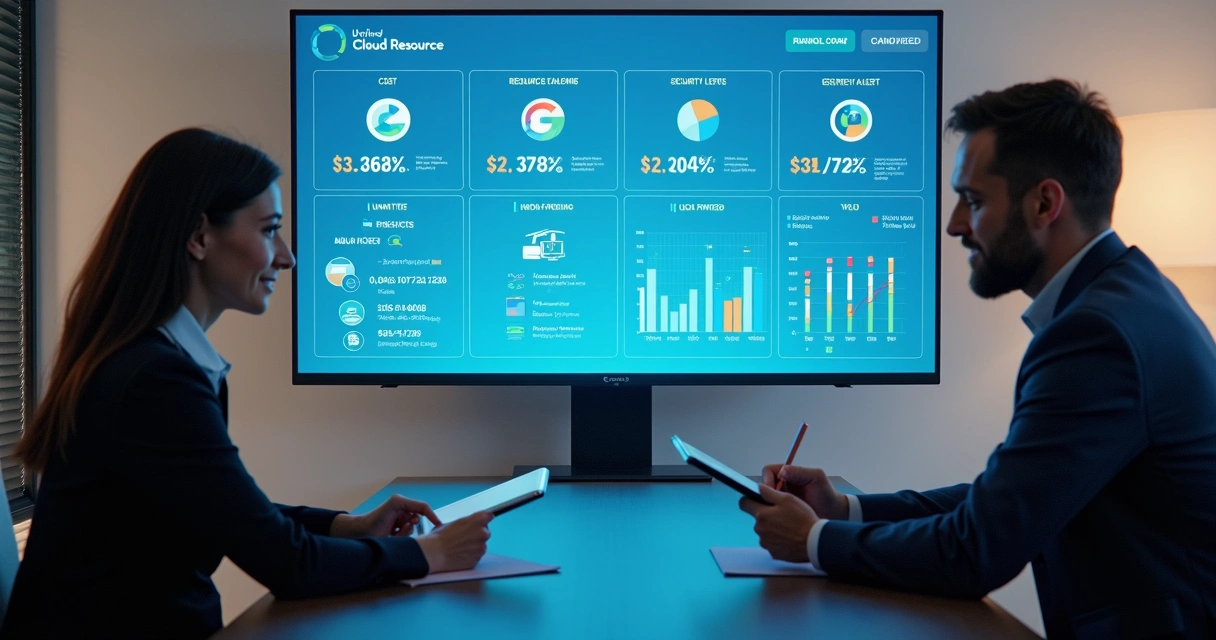
The only scalable way to manage multi-cloud operational complexity and prevent cost leakage is establishing centralized cloud governance. Rather than allowing engineering teams to manage individual cloud consoles in isolated silos, centralized governance creates a single operational standard across all providers.
Key pillars of effective centralized governance:
- Unified Asset Visibility: A consolidated real-time inventory of every compute instance, container, database, and storage bucket running across all cloud accounts.
- Standardized Identity and RBAC: Consistent Role-Based Access Control and Single Sign-On (SSO) ensuring the principle of least privilege applies equally across AWS IAM, Microsoft Entra ID, and Google Cloud IAM.
- Automated Policy Enforcement: Guardrails that prevent developers from launching non-compliant, unapproved, or excessively expensive resource tiers regardless of which cloud they deploy to.
- Shared Accountability: Providing engineering, DevOps, and finance teams with the exact same trusted real-time dataset.
How to track cloud spend across multiple providers
Accurate cross-cloud cost visibility requires a deliberate, automated tracking strategy:
- Enforce a Universal Tagging Taxonomy: Define mandatory tags across all providers:
Environment(production,staging,development)Owner(team-alpha,data-platform)CostCenter(engineering,marketing-analytics)Service(auth-api,billing-engine)
- Automate Daily Billing Ingestion: Connect read-only billing APIs across all cloud accounts into a centralized platform that normalizes cost records daily into a unified currency and schema.
- Configure Threshold Budget Alerts: Establish proactive alerts that notify team leads when projected monthly spend reaches 50%, 80%, and 100% of budgeted limits—catching spikes in real time rather than at month-end.
The multi-cloud cost optimization playbook
Achieving measurable cost reduction across multiple clouds requires moving beyond static reporting to active, automated optimization. Use this five-step playbook:
1. Continuous asset discovery and orphan cleanup
Cloud sprawl silently drains budgets through abandoned resources that run unnoticed. Continuously scan all accounts for:
- Unattached block storage volumes (AWS EBS, Azure Managed Disks, GCP Persistent Disks).
- Idle compute instances with < 5% CPU utilization over 14 days.
- Unassociated Elastic/Public IPs and unused Load Balancers.
- Old storage snapshots and unreferenced container images.
2. Workload rightsizing and resource optimization
Over-provisioning is the leading cause of cloud waste. Analyze actual CPU, memory, and network throughput telemetry to resize over-provisioned virtual machines and container tasks to match realistic workload requirements.
3. Cross-cloud commitment management
Analyze baseline, steady-state compute demand across your infrastructure. Strategically apply AWS Savings Plans, Azure Reservations, or Google Cloud CUDs to cover predictable workloads while keeping burstable, variable traffic on dynamically scalable on-demand capacity.
4. Automated non-production scheduling
Development and test environments do not need to run 24/7. Implement automated schedules to shut down non-production workloads overnight and during weekends, immediately cutting non-production infrastructure spend by up to 65%.
5. Policy-as-code guardrails against cost leakage
Embed cost controls into your CI/CD pipelines using Policy-as-Code (such as Open Policy Agent or Terraform validations). Automatically reject pull requests that attempt to deploy unapproved GPU instances, unencrypted storage, or non-compliant network configurations.
Tactical multi-cloud management with Cloud2Gether
Managing multi-cloud complexity and FinOps manually is unsustainable for growing teams. Cloud2Gether replaces fragmented spreadsheets and disconnected consoles with an intelligent, agentic control plane:

- Live Multi-Cloud Resource Catalog: Connects securely to your AWS, Azure, and Google Cloud accounts via lightweight agents, discovering every asset, dependency, and deployment artifact in real time.
- Normalized Daily Cost Ingestion: Ingests billing feeds daily, maps costs directly to your business units, and overlays native recommendations from AWS Trusted Advisor, Azure Advisor, and Google Cloud Recommender.
- Agentic AI Optimization: Autonomous agents patrol your cloud estate 24/7, pinpointing waste, identifying orphaned storage, detecting spending anomalies, and recommending concrete rightsizing actions.
- Reusable IaC Architecture Templates: Accelerate infrastructure deployment with expert-vetted, cost-aware Terraform and OpenTofu templates that enforce best-practice governance from day one.
What you can’t see, you can’t control. True multi-cloud efficiency begins with unified, actionable visibility.
Common multi-cloud mistakes to avoid
Even well-funded technology organizations fall into predictable traps when managing multiple clouds:
- Managing Each Cloud in an Isolated Silo: Assigning distinct teams to AWS, Azure, and GCP without common tooling creates disjointed security standards and fragmented spending oversight.
- Relying on Manual Spreadsheets for Cost Allocation: Cloud billing data changes continuously. By the time monthly billing spreadsheets are assembled, optimization opportunities have passed.
- Ignoring Data Egress Architecture: Failing to account for cross-cloud bandwidth charges leads to massive billing spikes when services in AWS communicate heavily with datastores in GCP or Azure.
- Postponing Tagging Enforcement: Attempting to enforce tagging retroactively after deploying hundreds of resources is significantly harder than requiring tags via CI/CD policy-as-code from day one.
- Over-Committing on Inflexible Reservations: Purchasing long-term Reserved Instances or Savings Plans on a single provider without factoring in planned workload migrations across clouds.
Conclusion: Tame cloud sprawl with unified intelligence
Multi-cloud architecture provides unmatched agility, redundancy, and leverage—provided you control the operational overhead. When engineering and finance share a single source of truth powered by automated inventory discovery and real-time FinOps, managing multiple clouds transforms from a chaotic liability into a strategic advantage.
Ready to eliminate cloud waste and take control of your multi-cloud spend? Explore how Cloud2Gether unifies AWS, Azure, and Google Cloud management.
Recommended external references
- TechRadar: Survey on IT Leaders Struggling with Cloud Costs
- Flexera: State of the Cloud Report
- FinOps Foundation: Multi-Cloud and Hybrid Cloud FinOps Framework
- AWS: Well-Architected Framework - Cost Optimization Pillar
- Microsoft Azure: Cloud Adoption Framework - Cost Management
- Google Cloud: Framework for Cloud Cost Optimization
Frequently asked questions
What is multi-cloud cost optimization?
Multi-cloud cost optimization is the discipline of monitoring, analyzing, and reducing infrastructure expenses across multiple cloud service providers (such as AWS, Microsoft Azure, and Google Cloud). It involves identifying orphaned assets, rightsizing over-provisioned workloads, automating non-production shutdowns, and leveraging cross-provider commitment models to achieve maximum ROI.
Why is managing multiple cloud providers more expensive than a single cloud?
Multi-cloud environments introduce hidden costs: cross-cloud data transfer (egress) fees, duplicated software licenses and monitoring tools, engineering context-switching overhead, and volume discount fragmentation. Without centralized governance, untracked resources and inconsistent billing schemas lead to significant cost leakage.
How do you track costs across AWS, Azure, and Google Cloud simultaneously?
Tracking cross-cloud spend requires establishing a universal tagging taxonomy (Environment, Owner, CostCenter, Service) and deploying an automated cloud management platform like Cloud2Gether. The platform connects via read-only APIs, ingests daily billing feeds, normalizes disparate SKUs into a unified currency and schema, and generates real-time spending anomaly alerts.
What is the difference between legacy tools (CloudHealth, Spot.io) and Cloud2Gether?
Legacy platforms focus primarily on post-facto billing analytics or spot instance management. Cloud2Gether provides an all-in-one agentic platform that pairs live multi-cloud resource inventory with daily billing feeds, native hyperscaler recommendations, automated drift detection, and pre-built Infrastructure as Code templates for both finance and technical leaders.
How can engineering and finance teams collaborate on FinOps?
Effective FinOps requires a shared source of truth. By centralizing real-time cost and resource telemetry in unified dashboards, engineering teams can see the direct dollar impact of their architectural choices, while finance gains clear visibility into unit economics and product profitability.
Continue Your Cloud Strategy Journey
A solid multi-cloud FinOps framework begins with structured migration and architecture planning. To learn more about modern cloud foundations, explore: